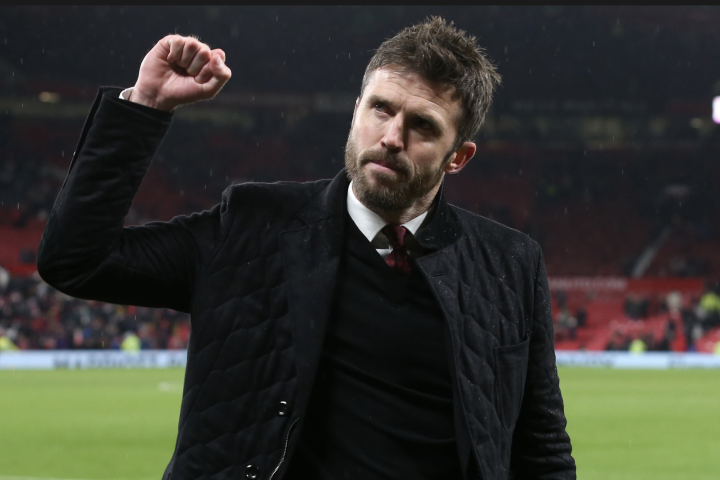
Manchester United have agreed a deal in principle to appoint club legend Michael Carrick as interim manager until the end of the 2025-26 season — a move that could prove transformational as the club searches for stability, identity, and direction following the departure of Ruben Amorim.
Carrick steps into a club currently seventh in the Premier League, trailing the title pace significantly and already out of domestic cup competitions. His first test could hardly be more demanding, with a Manchester derby against Manchester City looming — a fixture that will immediately define both belief and momentum under the new regime.
Carrick’s appointment is far more than a sentimental gesture. As a player, he spent 12 years at Manchester United, making 464 appearances and winning 10 major trophies, including five Premier League titles and the UEFA Champions League. Renowned for his intelligence, composure, and positional discipline, Carrick was often described as the glue that held elite United sides together.
His transition into coaching saw him work closely under José Mourinho and Ole Gunnar Solskjær, before stepping into management at Middlesbrough between 2022 and 2025. There, Carrick showcased his credentials as a progressive, modern coach. In his first full season, he took Boro from relegation danger to fourth place and a Championship play-off position, recording 13 wins in his first 17 matches — a remarkable turnaround built on confidence, structure, and attacking intent.
Across his tenure, Carrick’s teams ranked among the league’s strongest for goals scored, expected goals, shots per game, and touches inside the opposition box, underlining a philosophy rooted in dominance and control rather than reactive football.
Carrick’s tactical approach stands in stark contrast to the instability that has plagued United this season. His preferred system is a 4-2-3-1, designed to establish midfield control through a disciplined double pivot, encourage structured build-up play from the back, prioritise positional intelligence over frantic pressing, and grant creative freedom to attacking midfielders.
In possession, Carrick’s sides often evolve into a 3-2-4-1 shape. One full-back steps into midfield to support ball circulation, while the other pushes higher to stretch the pitch, allowing United to overload central areas without sacrificing defensive balance. This tactical flexibility enables sustained territorial dominance while remaining compact out of possession.
Carrick has also demonstrated adaptability with a 4-3-3 system, particularly when additional midfield control is required or when protecting narrow leads — an approach that suits Manchester United’s current squad depth and technical profile.
For years, supporters have demanded a return to football that reflects United’s traditional DNA: attacking, possession-based, and fearless. Carrick’s philosophy aligns seamlessly with those principles.
His teams prioritise ball retention and tempo control, build attacks through measured progression across the thirds, maintain positional discipline to reduce exposure on the counter-attack, and place creative responsibility on intelligent, technically gifted players rather than relying on individual moments alone.
This approach contrasts sharply with the inconsistency seen under Ruben Amorim, whose back-three system struggled to translate into Premier League success. Amorim departs with the lowest win percentage of any permanent Manchester United manager, leaving behind a squad uncertain of its identity.
Carrick’s return to a structured back four and controlled midfield play offers immediate clarity — something the squad has lacked throughout the campaign.
Carrick is expected to implement a familiar 4-2-3-1 system that maximises balance and creativity. A central striker would lead the line, supported by two wide attackers and Bruno Fernandes operating as the central attacking midfielder. Behind them, a double pivot — likely featuring Casemiro and Kobbie Mainoo — would provide defensive stability and progression through midfield. A back four and a single goalkeeper would complete the structure.
This setup allows Fernandes to operate as the creative heartbeat of the side, supported by disciplined midfielders who can control tempo, while wide attackers provide movement, width, and penetration. The shape can also adapt seamlessly into a 4-3-3 or a 3-2-4-1 during phases of possession, giving Carrick tactical flexibility against both deep defensive blocks and elite opponents.
With nearly half the season remaining and European qualification still within reach, Carrick’s immediate objective will be to stabilise performances, restore confidence, and close the gap on the top four. However, his influence could extend far beyond results alone.
Carrick brings authority through experience, instant respect within the dressing room, a calm and methodical leadership style, and a tactical bridge between Manchester United’s historic identity and the demands of modern football. His presence also offers continuity ahead of a crucial summer rebuild, ensuring that the next permanent appointment inherits a squad with structure rather than chaos.
Michael Carrick’s return is not merely a stopgap solution. It represents a reset of values, a re-establishment of footballing intelligence, and a reconnection between Manchester United and its identity.
In a season defined by turbulence, Carrick offers clarity. In a club craving belief, he brings trust. And while the role may be labelled “interim,” the impact could resonate long after the final whistle of the campaign.
For Manchester United, this is not about nostalgia — it is about rediscovering who they are.