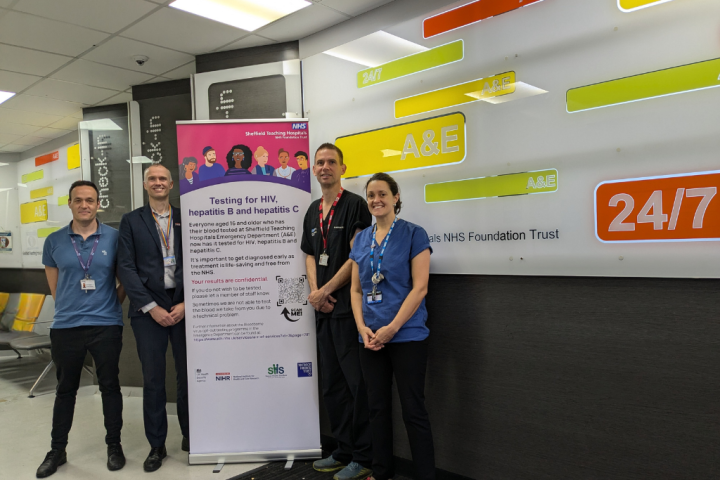
After rolling out routine opt-out blood borne virus testing in its emergency department, Sheffield Teaching Hospitals NHS Foundation Trust is celebrating its role in helping to save lives.
Routine opt-out testing for HIV, Hepatitis B, Hepatitis C in NHS emergency departments across the country has been a gamechanger for the early detection of HIV and viral hepatitis – enabling thousands more people to get access to life-saving treatments, which prevent long-term health issues and reduce the chance of passing the virus on to others.
So far, the scheme has helped over 11,000 people nationally with a new diagnosis of a blood borne virus – which equates to 275 newly diagnosed individuals a month.
Figures – published to coincide with this year’s World Aids Day (1st December 2025) – show that Sheffield Teaching Hospitals NHS Foundation Trust has successfully tested almost 40,000 patients for blood borne viruses since introducing the scheme in the Northern General Hospital’s A&E and emergency department. The scheme has helped to find 75 new people with a blood borne virus, including 25 Hepatitis C, 43 Hepatitis B and 7 HIV cases – and although these numbers may seem small, they are largely significant in terms of reduction of future health complications and prevention of onward transmission of infection and new cases.
Speaking on condition of anonymity, one patient, who had a condition detected thanks to the scheme said: “Routine opt-out testing in A&E departments saves lives. It saved mine and stopped me from passing on the virus to others. Eventually, you could say it gave me a new purpose and perspective.’’
Another, who also asked to remain anonymous, said: “When I felt unwell and went to ED, it was a lifesaver – I got diagnosed with HIV and I wouldn’t have known otherwise. It was a really positive experience for me’’
Early detection and diagnosis of Hepatitis B and C can result in getting treatment quickly that can reduce the risk of developing serious illness or complications (such as liver cirrhosis and cancer) – and in the case of Hepatitis C, treatment can also be curative.
Treatment for HIV suppresses the virus – allowing people to live a normal life as well as preventing infection from being passed on. If HIV is undetectable, it is un-transmittable.
Consultant in Infectious Diseases and Acute Medicine at Sheffield Teaching Hospitals NHS Foundation Trust, Dr Rachel Foster, said: “We are proud to improve the lives of the people we serve and target viruses that affect our community. We also hope the scheme will normalise testing for HIV and thus reduce associated stigma.”
To spread the news about the importance of testing for patients, posters advertising the scheme are now available in the A&E and emergency department, but if patients do not require a blood test during their visit to the emergency department, they will not be tested. Patients can also opt out of testing by speaking to a member of staff.
For anyone whose result does come back positive, specialist support will be given to them – where they will be linked to specialist care, treatment and support.
Although blood-borne viruses can cause serious illness and complications, they can be largely prevented through early diagnosis, specialist assessment and effective treatment or monitoring – and with Sheffield Teaching Hospitals NHS Foundation Trust having recently received an additional £150,000 funding to continue to deliver the programme in its emergency department until March 31st, 2026, it will continue to save lives.