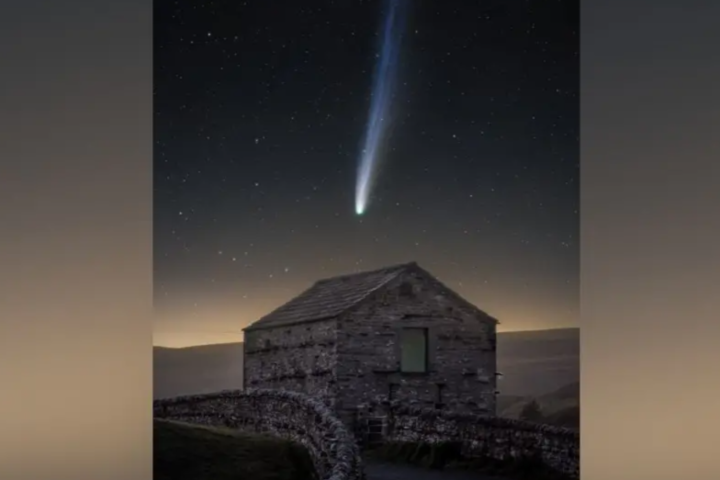
A photographer who captured Comet Lemmon in the night sky above the Yorkshire Dales said he spent weeks waiting for the perfect moment to take his shot.
Dominic Reardon, a 29-year-old from Arnside in Cumbria, travelled to the village of Muker in North Yorkshire on 25 October to photograph the celestial visitor that will not return for more than a millennium.
Comet Lemmon, officially designated C/2025 A6, was first detected in January by astronomers at the Mount Lemmon Survey in Arizona. The non-periodic comet made its closest approach to Earth on 21 October 2025, passing at a distance of 56 million miles (90 million kilometres). Astronomers have confirmed that it will not return for around 1,150 years, making it a once-in-a-lifetime sight.
For Mr Reardon, capturing the image was the culmination of patience, planning and perseverance. “I’d been trying to find a gap in the weather for two weeks and had tried a couple of times before, but I would get fully set up – which takes a good 30–45 minutes – only to have the night ruined by clouds, rain or wind,” he said. “I had thought I wasn’t going to get chance to capture it, and then finally got an opportunity. I was excited and relieved.”
He said he had been “watching the weather forecast like a hawk” as unsettled skies repeatedly thwarted his attempts. On the night of 25 October, conditions finally aligned. Using a telephoto lens and a star tracker, he was able to follow the comet’s slow movement across the sky and collect more light and image data. Over the course of two hours, between 19:00 and 21:00, he took multiple long-exposure shots to record both the comet’s tail and the surrounding starlight.
A star tracker is a specialised mount that moves the camera in sync with celestial objects, compensating for the Earth’s rotation. This allows longer exposures without the stars blurring, and it enables the capture of faint details such as a comet’s nucleus and surrounding coma. Mr Reardon used this equipment to bring out Comet Lemmon’s greenish glow and the faint dust tail sweeping through the dark autumn sky above the Yorkshire Dales.
He also employed a different photographic technique for the foreground, capturing the local building separately before blending the images together to produce the final composite. The result is a striking contrast between the still landscape of North Yorkshire and the fleeting cosmic traveller passing overhead.
As of 29 October 2025, Comet Lemmon had an apparent magnitude of around 4.2, meaning it was visible to the naked eye under dark skies and easily observable through binoculars. Sky watchers noted it could be found about 30 degrees to the upper left of Arcturus, the bright orange star that forms part of the constellation Boötes. The comet coincided with the annual Orionid meteor shower, which the Royal Astronomical Society said would remain visible until 7 November.
When first discovered, astronomers expected the comet to reach a magnitude of only 10, far too dim to be seen without a telescope. However, as it neared the Sun, it brightened dramatically, exceeding initial estimates by roughly 400 times to reach a magnitude of about 3.5. This surprising change turned Comet Lemmon into one of the brightest comets of recent years, attracting attention from professional observatories and amateur stargazers alike.
The Mount Lemmon Survey, which discovered the comet, operates from the Santa Catalina Mountains near Tucson, Arizona. Its primary mission is to identify near-Earth objects such as asteroids and comets that may pose a hazard to Earth. In this case, however, Comet Lemmon has proven more of a gift than a threat, providing astronomers with valuable data and photographers with an extraordinary opportunity.
For Dominic Reardon, that opportunity was worth every cold evening spent watching the sky. “It was one of those moments where everything came together,” he said. “I’d been so close to giving up, but once the clouds cleared, it was absolutely worth the wait.” His photograph of Comet Lemmon over the Yorkshire Dales captures not just a rare astronomical event, but also the quiet persistence required to witness it.