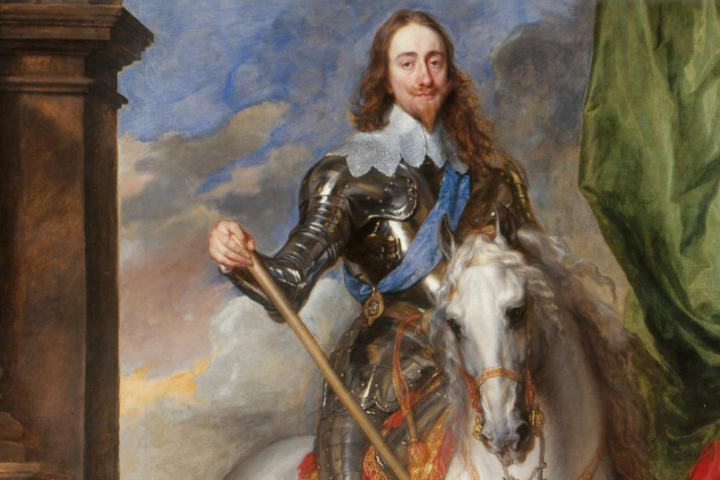
A previously unknown episode from the English Civil War has emerged from the margins of one of Leeds’s most important historical books, revealing a daring but unsuccessful attempt to free King Charles I during his imprisonment in the city.
The story appears in handwritten notes found in Leeds Central Library’s unique copy of Ducatus Leodiensis, the foundational text of Leeds local history. The annotations describe how, in 1647, the King was offered an escape from Red Hall in the city centre by disguising himself in women’s clothing. The proposal was declined.
This account is believed to be recorded in writing for the first time within these notes, which were added decades after the events themselves. They were written by Thomas Wilson, an antiquarian contemporary of Ralph Thoresby, whose original work forms the core of the book.
Printed in the mid 1740s, this particular edition of Ducatus Leodiensis is one of a kind. The marginal notes added by Wilson expand upon Thoresby’s already detailed study of Leeds, capturing local stories that had previously circulated only through oral tradition.
According to the annotations, the escape plan was devised by Mrs Crosby, a servant to wool merchant Thomas Metcalf. She reportedly offered to supply the disguise and to lead the King out through a garden door on Lands Lane under cover of darkness, allowing him to slip away from Leeds unnoticed.
Although Charles I refused the plan, the notes state that he thanked Mrs Crosby by giving her his garter. He instructed her to present it to his son should he ever ascend the throne, along with the story of how she came to possess it.
Years later, after the execution of Charles I in 1649 and the restoration of the monarchy, this event became part of royal family memory. When Charles II took the throne, Mrs Crosby presented him with the garter as promised. Her husband was subsequently appointed High Bailiff of Yorkshire in recognition of her actions.
The episode adds a striking new dimension to Leeds’s historical record. Ducatus Leodiensis was first published in 1715 and remains the most comprehensive early account of the town and parish of Leeds and surrounding areas in the West Riding of Yorkshire. The book contains family trees, coats of arms and detailed illustrations of landmarks including Kirkstall Abbey.
Ralph Thoresby, widely regarded as Leeds’s first historian, devoted much of his life to documenting the city’s past. The son of a merchant, he combined meticulous research with extensive collecting to preserve records that might otherwise have been lost.
Antony Ramm, special collections librarian at Leeds Central Library, said: “Before Thoresby set to work on the Ducatus, Leeds was of course already a city steeped in history.
“But his exhaustive research and irrepressible dedication to compiling such a comprehensive record of the city’s heritage may well have prevented many of these fascinating events and stories being lost in time.
“Thoresby’s work was also the spark which inspired generations of fellow historians to follow in his footsteps and create their own bigger, and even more elaborate histories, in turn ensuring an ever evolving record of the city’s story was captured through the ages.”
Among those influenced by Thoresby was nineteenth century historian William Boyne, whose seven folio History of Leeds is also held by the library. Boyne’s work includes detailed maps, genealogies, images of sites such as Temple Newsam and Kirkstall Abbey, and records of notable antiquities.
Councillor Asghar Khan, Leeds City Council’s executive member for communities, customer services and community safety, said: “Seeing the city’s early history laid out in such impressive fashion on the pages of these remarkable books brings home just how prestigious the story of Leeds really is.
“We’re extremely fortunate to have such a comprehensive archive of the city’s story which will be preserved for future generations.”
Thoresby’s Ducatus Leodiensis, including the newly highlighted notes on the attempt to rescue King Charles I from Leeds, is currently on display in the local and family history section of Leeds Central Library.