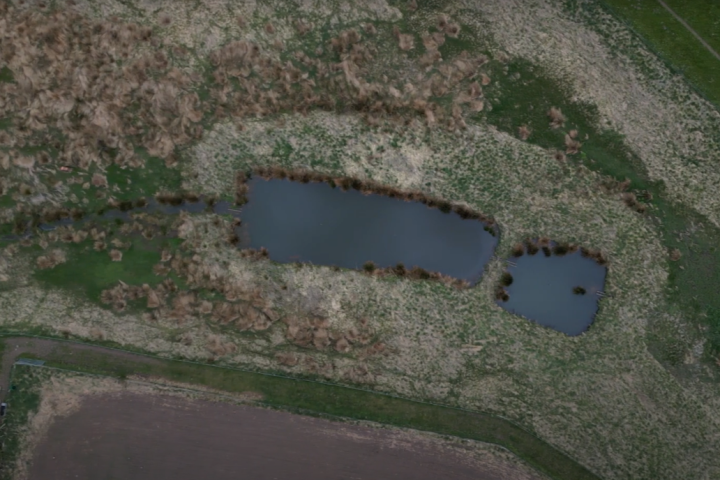
A research project in Cumbria is shedding light on how simple on-farm features, such as sediment ponds, can help farmers manage runoff, protect valuable soil, and support valuable biodiversity – all while contributing to national efforts to improve water quality.
Designed to trap soil, nutrients and pollutants before they reach rivers and streams, sediment ponds are small, purpose-built bodies created through agri-environment schemes (AES) and Catchment Sensitive Farming (CSF) advice.
These runoff-control features are now also being recognised for another critical function, supporting aquatic life and boosting farm-level biodiversity – from mayflies to barn owls.
This Loughborough University project is being carried out by PhD researcher Charlie Patel in partnership with supervisors Professor Paul Wood and Dr. Kate Mathers, Dr. Jessica Durkota from the Environment Agency and Professor Adrian Collins from Rothamsted Research – and the sites are based in Penrith and Calthwaite.
The study aims to look below the surface (literally) by not only focusing solely on how much sediment and nutrients the ponds capture, but also exploring how these ponds support macroinvertebrate communities, including beetles, mayflies, snails, and other water-dwelling invertebrates.
“These ponds act like mini wetlands,” said PhD researcher Charlie Patel. “They slow down the water, allowing sediment to settle, and prevent nutrients like phosphorus from entering nearby rivers.
“But they also offer a habitat for aquatic insects, amphibians, and birds in landscapes where natural habitats such as ponds have largely disappeared.”

Researcher Charlie Patel examines the biodiversity of one of the sediment ponds. Loughborough University.
The dual function of pollution control and biodiversity support offers real benefits for farmers as erosion and nutrient runoff not only harm the environment but also represent a loss of productive soil. By keeping the sediment on-farm, ponds allow farmers to potentially reclaim and reuse valuable soil that would otherwise be lost downstream.
Additionally, as extreme weather events become more frequent, the ponds help store heavy rainfall, protecting fields, infrastructure, and nearby communities from flood risk: “That’s a win for farmers and for the environment,” said Charlie.
A farmer at High Oaks Farm in Calthwaite, Joe Lycall, installed two such ponds on his land in the Northwest of England about seven years ago. Each pond is just five-by-five metres – but able to catch runoff from a catchment area of over 60 acres – which Joe has said have helped stabilise the land, improve crop health, and reduce nutrient loss from the soil.
As a result of climate change, farmers are facing soil becoming more saturated – increasing the runoff across agricultural land which is causing more frequent and severe flooding.
Joe recalls the devastation of Storm Desmond in 2015, and how ponds like his can help buffer future shocks.
“They hold back some of the floodwater during heavy rain, slowing its path through the landscape,” he explained. “It’s a form of natural flood management that really works.”
Winton Hill Farm manager, James Turner, agreed with this, describing that sediment ponds as a ‘critical missing piece’ in how we manage our water systems.
“They’re part of a wider toolkit,” said James. “Used alongside things like buffer strips and wetland restoration, they help restore the balance between farming and nature.”

Two ponds at High Oaks Farm. Loughborough University.
Beyond these benefits for farming and flood control, the ponds are also proving to be a magnet for biodiversity – where, on Joe’s farm alone, they’ve helped improve a trout habitat in local streams and sparked a rise in birdlife.
“We’ve seen herons, damselflies, and yellowhammers come back,” said Joe. “It’s great to hear the birdsong again – it makes you feel like you’re doing something right.”