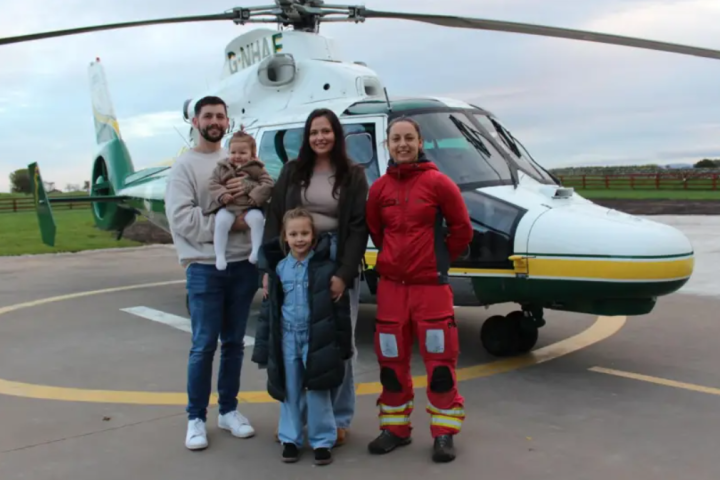
A couple’s evening out turned into a medical emergency when their 11-month-old daughter was airlifted to hospital, highlighting the essential role and funding challenges faced by the Great North Air Ambulance Service (GNAAS).
Olivia Brummitt and Dan Atkinson, from Brough, had left their two children, aged 11 months and six years, with relatives while they went for a meal in Carlisle. Shortly after finishing dinner, they received a call informing them that their baby daughter, Winnie, was having seizures.
According to Olivia, Dan’s father reported that Winnie’s “eyes were rolling back” and that she had become unresponsive. “It was the stuff of nightmares… we could hear our other daughter Ada crying and her nana was having to do CPR,” she said. “Winnie was playing happily at her grandparents house when she went completely vacant and then she started shaking and her eyes rolled back.”
An ambulance reached the property within 45 minutes, but due to the severity of the situation, the Great North Air Ambulance Service was deployed to fly Winnie to James Cook University Hospital in Middlesbrough for emergency treatment.
Olivia said she “did not realise how serious it was until the air ambulance was called” and described feeling “totally powerless”.
At hospital, Winnie was placed in an induced coma and stabilised. She has since been discharged and is awaiting the results of an electroencephalogram. Olivia said, “GNAAS saved her life. The same journey by road would have been more than an hour.”
The Great North Air Ambulance Service confirmed it responds to more than 2,000 incidents each year across north-east England, Cumbria, North Yorkshire and the Isle of Man. The charity currently operates two helicopters, but both are approaching the end of their “economically viable life”.
GNAAS has warned that it may be forced to scale back its operations unless it can raise sufficient funds to replace its ageing aircraft. The organisation is seeking to raise £2.5 million for a deposit on a third helicopter to maintain its current service levels.
The incident involving Winnie is one of thousands each year in which the Great North Air Ambulance Service provides rapid emergency response to critically ill or injured patients. The service operates entirely through charitable donations and receives no direct government funding.
In this case, the use of the air ambulance significantly reduced transport time for the patient and enabled hospital staff to begin treatment sooner than would have been possible by road.
The charity has stated that maintaining its current response capability depends on continued public support, with fundraising efforts under way to secure the future of its fleet.