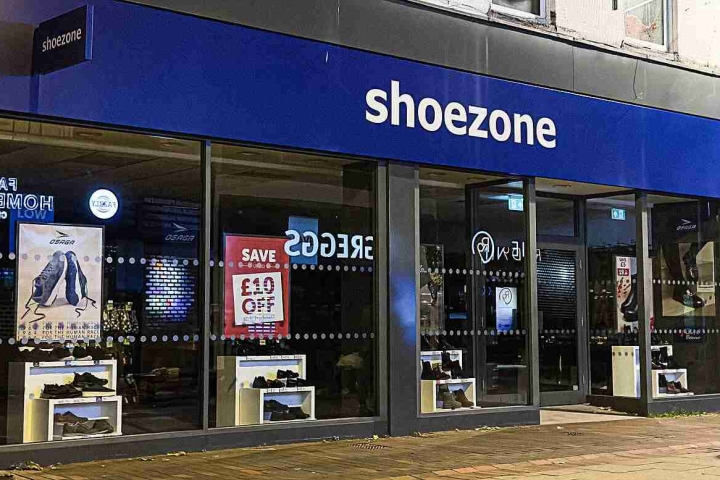
Shoe Zone, the Leicester-based, nationally trading footwear retailer with more than a century of history and over 260 branches across the UK, has reported a significant decline in revenues and pre-tax profits for the year ending 27 September 2025, as adverse trading conditions continue to impact the UK high street.
The company’s revenue for the period fell to £149 million, down from £161.3 million in 2024, while pre-tax profits dropped sharply from £10.1 million to £3.2 million. The decline reflects the combined effect of weaker consumer confidence, persistent inflation, higher interest rates, and reduced disposable income.
Chairman Charles Smith described the year as “particularly challenging,” noting that economic pressures intensified following the UK government’s October 2024 Budget, which contributed to heightened consumer caution. “Sales were good when there was a reason to buy, such as during the warm summer months and the back-to-school period; however, discretionary spending remained subdued as households managed tighter budgets,” he said.
The company made further operational adjustments during the year, closing 39 stores, opening 11 new outlets, and refitting six stores to its larger-format design, leaving the total store count at 269. Smith noted that these changes were “consistent with management expectations” and form part of an ongoing strategy to optimise store performance amid volatile trading conditions.
Looking ahead, Smith warned that early 2026 trading remains difficult. He highlighted that the November 2025 Budget, which included an additional increase in the National Living Wage, added further pressure to the company’s cost base, while broader fiscal measures have had limited effect on boosting consumer sentiment. In light of this, Shoe Zone now expects pre-tax profits of approximately £1 million for the financial year ending 3 October 2026.
Despite the downturn, the company reported a strong year-end cash position, which increased by 64% to £5.9 million, providing the business with flexibility to continue investing in strategic priorities and navigate ongoing economic uncertainty. “Cash generation is expected to continue into 2026, leaving the business well positioned to capitalise when conditions improve,” said Smith.
Shoe Zone’s roots stretch back over 100 years, having been founded in 1917 as Bensonshoe. Over the decades, it has grown into a national retailer with more than 270 stores across the UK and a workforce exceeding 2,200 employees. Strategic acquisitions—including The Oliver Group in 2000, Shoefayre in 2007, and Stead & Simpson in 2009—helped expand its footprint significantly. The retailer sells approximately 16 million pairs of footwear annually and supports charitable work through the Shoe Zone Trust, which has raised over £2.3 million for children’s charities as of May 2022.
Smith concluded by reaffirming the board’s focus on disciplined cost management and long-term strategic growth: “Despite the headwinds, our priority remains delivering resilience and value for both our customers and shareholders. We remain confident that, with the strong cash position and continued focus on operational efficiency, Shoe Zone is well placed to benefit when consumer confidence returns to the UK high street.”