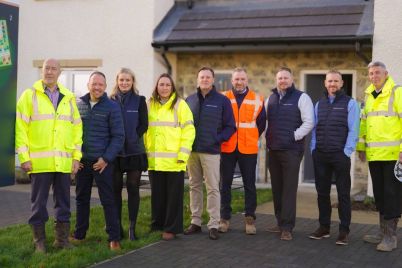
The Jobs Foundation has officially launched its Yorkshire Business Council, an initiative aimed at helping people move from welfare into work. As an independent and non-partisan charity, the Jobs Foundation was co-founded in 2022 by president Lord Matthew Elliott and chief executive Georgiana Bristol. Its stated mission is to champion businesses as a “force for good” by creating job opportunities and supporting training programmes.
The launch event took place at Sheffield College’s Pennine Five Campus on 25 November. Kellen Hadfield, business council manager at the Jobs Foundation, explained: “We travel the country looking at what businesses and charities are doing really well in terms of hiring and training staff. We looked at cohorts of the most disadvantaged people and how businesses can do more to guide them into the workplace.”
The Yorkshire Business Council is part of a broader regional strategy. The Foundation’s research and policy work is supported by its National Business Council, which comprises more than 1,300 businesses across the UK. Hadfield added: “As our coalition has grown we’ve realised that it’s not enough to be national. We need to have footholds in every region of the UK.” Earlier this year, regional councils were launched in the North East and South West, with Yorkshire now following suit.
Ken Ross, principal of RBH Properties and sponsor of the launch event, said: “To bring organisations like the Jobs Foundation to Sheffield is a huge honour for us. We have a great mix of people, with Sheffield College, deep tech industries and over 100 different companies here. At RBH, we try to scaffold the route into opportunities. But there are gaps and people who still don’t realise that organisations are there to help them succeed.”
Official figures highlight the scale of the challenge. The Office for National Statistics reports that 9.08 million people aged 16 to 64 in the UK are economically inactive.
The Foundation also highlighted examples of best practice. Georgiana Bristol interviewed Edward Naylor, chief executive of Naylor Industries, a Barnsley-based company that has grown from clay pipe manufacturing into producing concrete, plastic extrusion and technical construction products. Naylor Industries operates across seven UK sites, employing around 400 people.
“Communication is absolutely vital to success,” said Naylor. “But as we’ve grown our sites, it’s become harder. We’re trying to create a sense of shared purpose – all pulling in the same direction.” He emphasised the importance of bringing young people into the business: “We’ve got two ways of doing this: one is an active apprenticeship scheme where, every year, we’ll hire 6-8 apprentices. If you can get young people interested and enthused, you get extraordinary payback. We’ve also had management trainees, having sponsored four individuals through business study degrees at Sheffield Hallam University.”
Naylor Industries also focuses on gender equality. “We’re focused on giving females opportunities in management. The imposter syndrome is well documented, so we set up a confidential mentoring programme where there is a voice at the end of the phone, which hopefully gives females confidence to be able to take on more responsibility and ultimately get promoted into the senior levels of the business.” The company works with Horizon Community College in Barnsley to engage young people at the pre-work level, helping with CV writing, mock interviews, and promoting STEM opportunities for females.
Panel discussions at the launch emphasised the wider social impact of business-led initiatives. Martin McKervey, chairman of the Jobs Foundation Yorkshire Business Council, noted the commitment to both environmental and employment outcomes: “Our success is not measured just in terms of profit and productivity, but also in the jobs, skills and life chances we want to create for young people and the communities in which we work across South Yorkshire and beyond. Sadly, too many young people are lost with little sense of attainment, aspiration and ambition. But when we work together as businesses and help these people, we see their talent, ambition and ability. Work and good jobs transform lives and communities.”
Lord Elliott outlined proposals to incentivise employers, including national insurance exemptions for hiring from welfare and tax credits for workforce training. Kate Josephs, chief executive of Sheffield City Council, stressed the importance of local engagement and long-term funding for employment and skills programmes, highlighting initiatives such as Pathways to Work in Barnsley.
Kamran Rashid, founder of Impact Hub Yorkshire, spoke on the importance of social enterprises and organisational culture. “If businesses measure success by profit, and charities measure success by the impact on social objectives, a social enterprise measures success by what we call the ‘triple bottom line’: impact on people, planet, and profit. Employers need to take responsibility for creating a resilient workforce. We need to not see employment as one thing and public services as another. They’re interconnected.”
The launch of the Yorkshire Business Council represents a coordinated effort to reduce economic inactivity through business engagement, skills development, and social impact initiatives, with a clear emphasis on regional presence and collaborative working.