Archaeological finds uncovered during a major Leeds transport scheme are offering a rare, continuous glimpse into thousands of years of local history, following their preservation at a city museum.
Items spanning more than six millennia have been transferred into the care of Leeds Discovery Centre after being recovered during construction of the East Leeds Orbital Route. The scheme, the largest infrastructure project undertaken by Leeds City Council in half a century, prompted extensive archaeological investigation along its seven kilometre corridor.
Specialists from Wessex Archaeology were commissioned to survey and excavate land across the entire route, identifying sites of historic interest and ensuring artefacts were carefully recorded and assessed. Their work revealed material from almost every major period of human activity in the area.
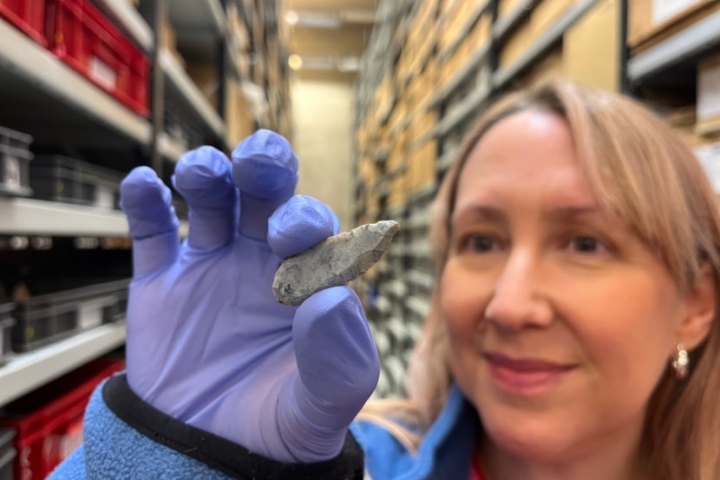
Among the earliest objects recovered was an Early Neolithic leaf-shaped arrowhead made from flint around 6,000 years ago. The fine detail of the knapping marks remains visible. A bronze alloy flat axe head dating back more than 4,000 years was also discovered, alongside a dark blue glass bead from the Late Roman period.
Later finds included pottery dating from before the Norman Conquest, a post-medieval buckle and evidence linked to the deserted medieval settlement of Morwick. More recent artefacts ranged from an 18th century pair of nutcrackers to a clay pipe bowl carved with a seated figure of Britannia, believed to date from the 1840s.
Kat Baxter, curator of archaeology at Leeds Museums and Galleries, said: “What makes this such a fascinating archive is its sheer scope and scale. What we can see is a snapshot of different people and communities who have been in this part of Leeds over thousands of years.
“Whether they lived here in the Stone Age or the Medieval period, archaeology gives us the opportunity to imagine the lives of those who were here before us. It also underlines the importance of preserving archaeological archives for future generations as a record of the city’s heritage and the rich history beneath our feet.”
Ashley Tuck, research manager with Wessex Archaeology, said the completion of the archive marked a significant milestone. “There’s a great sense of satisfaction in seeing the archive from this project in the permanent collection of Leeds Museum for the local community to care for and explore in the future. Our work has revealed much about the history of the area to the north and east of Leeds, spanning almost every period.
“The project has seen contributions from a range of experts, from field archaeologists, geophysicists, finds and environmental specialists, to researchers, archivists and many others. We look forward to publishing the final results later this year.”
The artefacts are now housed at Leeds Discovery Centre, which combines secure storage with public access. The facility holds archaeological archives from across the Leeds Metropolitan District and supports exhibitions, learning programmes and research.
Councillor Salma Arif, Leeds City Council’s executive member for adult social care, active lifestyles and culture, said: “Each of these objects tells its own small part of the story of east Leeds, and seen together, they really capture what a rich and fascinating story that is.
“Collecting these amazing finds is also such a huge and important part of what museums like ours do too, ensuring our local heritage is preserved for future generations and that these historic objects are not lost in time.”
A selection of objects from the East Leeds Orbital Route archive is due to go on display at the Leeds Discovery Centre in spring 2026. The centre is open for pre-booked tours and operates as a Give What You Can museum, with visitors invited to donate if they are able.